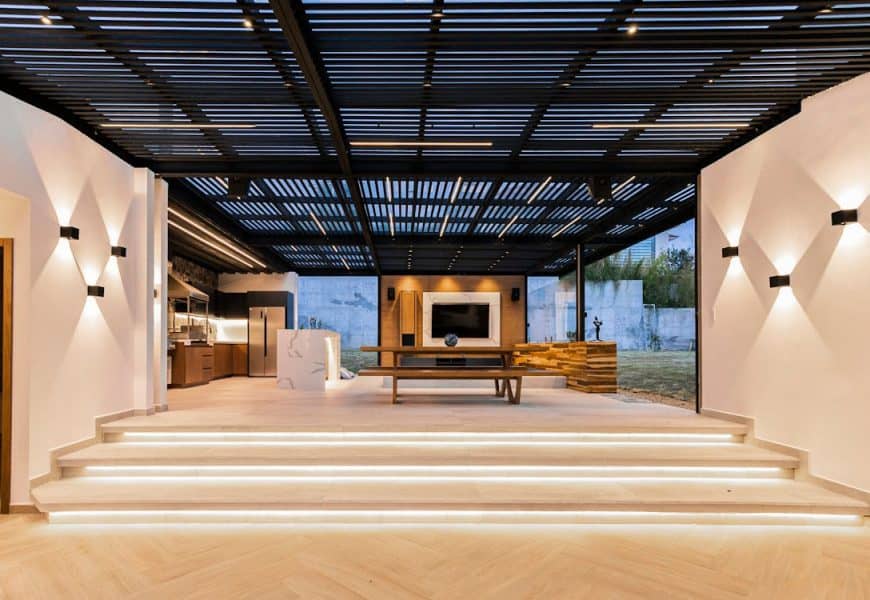
For years the pergola-versus-cabana debate had a clean dividing line. Pergolas were open and let sun through; cabanas enclosed a space and kept weather out. A newer category has blurred that line, and it is reshaping how homeowners think about shade. Bioclimatic pergolas, the motorized louvered systems that adjust on demand, are now a fast-growing segment, with the global market projected to reach $821.2 million by 2030.
The appeal is simple once you see one work. A bioclimatic pergola has a roof of aluminum louvers that tilt, rotating from fully open to fully closed at the touch of a control, with many systems shedding rain when shut. That single capability collapses much of the old trade-off between a pergola and a cabana.
The Old Trade-Off, and Why It Existed
A traditional fixed pergola is a compromise by design. Its open slats filter sunlight, which is lovely in the morning and inadequate at two in the afternoon in July. Owners patched the gap with climbing vines, fabric tops, or retractable canopies, each of which helped a little and aged in its own way.
The cabana solved the shelter problem by giving up openness entirely. You got privacy and protection, but you also got a visually dominant structure that consumed more yard and cost considerably more to build. For a lot of homeowners, neither option was quite right.
That is the friction the louvered system targets. By making the roof adjustable, it offers a pergola’s openness when you want light and air and something close to a cabana’s shelter when you close the louvers against sun or a passing shower. The structure adapts to the hour instead of forcing a single permanent choice.
Industry analysts describe these as climate-responsive structures built with motorized adjustable louvers and, in higher-end versions, sensors and weather controls. The category sits between the two traditional answers, which is exactly why it has grown into its own market rather than staying a niche upgrade.
Why the Shift Lands Hard in Southern California
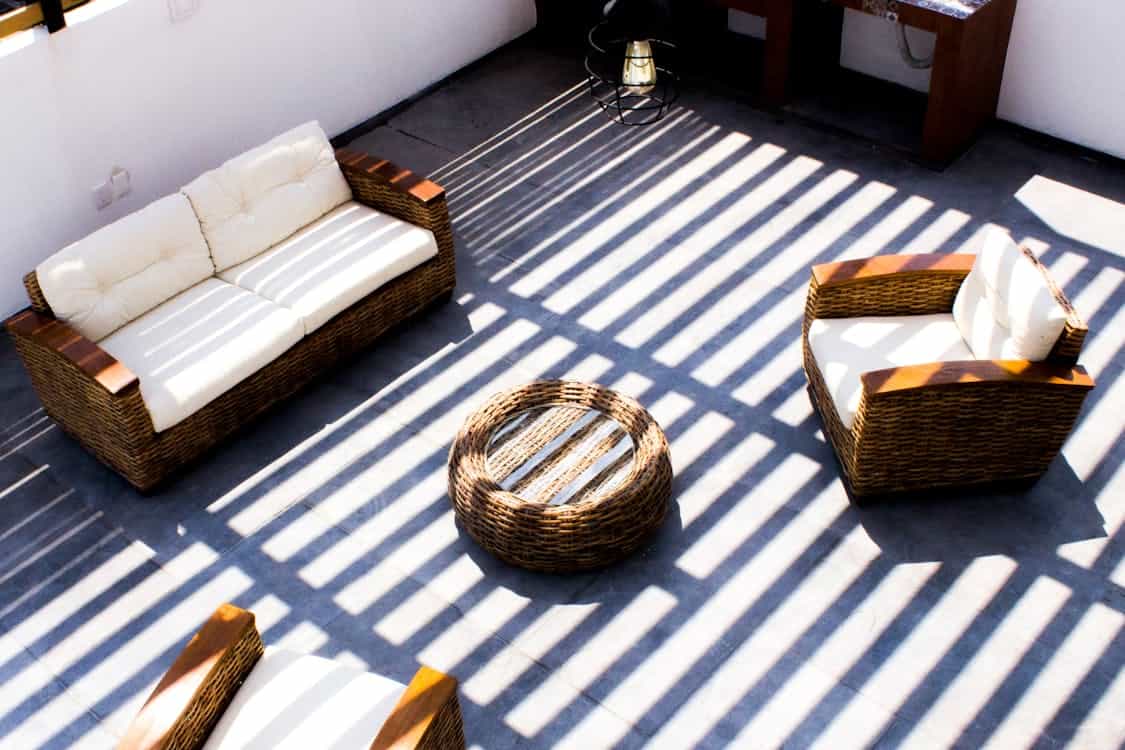
The bioclimatic concept matters more in some climates than others, and Southern California is squarely in its sweet spot. The region’s long, sunny, dry stretches are precisely the conditions where a fixed pergola underperforms and a homeowner wants to dial in shade through a hot afternoon.
Coastal exposure adds a second reason. Aluminum, the dominant material in these systems, resists the rust and corrosion that punish other metals near salt air, which is the same reason aluminum already gets recommended for fixed pergolas on the coast. The louvered systems inherit that durability advantage.
There is an energy and comfort angle, too. By modulating sun and airflow, these structures function as passive cooling for the patio beneath them, keeping an outdoor room usable across more of the day and year. In a place where outdoor living is a central part of how homes are used, that extended usability is the whole value proposition.
The catch is cost. Motorized louvered systems run well above a simple fixed pergola, and adding sensors and automation pushes the figure higher again. For budget-sensitive buyers, that premium is a genuine barrier, and a well-built fixed pergola with a good canopy remains a sensible answer.
Where This Leaves the Classic Decision
None of this makes the old pergola or cabana obsolete. A fixed wood pergola still offers warmth, lower cost, and a classic look that blends into a garden. A cabana still wins where the real need is privacy, enclosure, and a poolside room with storage. The louvered system did not replace those; it added a third path.
What changed is the framing of the decision. The question used to be open versus enclosed, a permanent commitment made at install. Now there is an in-between that lets a homeowner defer that commitment to a daily setting, at the price of a more complex and more expensive structure.
For homeowners weighing the options, the honest filter is use and budget. If you want shade you can tune through the day and you can absorb the premium, a bioclimatic system is compelling. If cost is the constraint or the look you want is rustic and planted, a fixed pergola still makes sense. If privacy and poolside shelter are the goal, the cabana keeps its edge.
The market trajectory suggests these adaptive structures will keep taking share as prices ease and the technology becomes familiar. But the underlying lesson is not that one structure won. It is that the backyard shade decision now has more than two honest answers, and the right one still depends on the lot, the climate, and the wallet in front of it.
It is also worth being clear-eyed about maintenance and complexity. A fixed wood pergola can be repaired by almost any handy owner, while a motorized louvered system introduces motors, controls, and sometimes sensors, all of which are points that can eventually need service. The adaptability is real, but so is the added machinery behind it.
For most homeowners the decision comes down to how often they would actually use the adjustability. Someone who entertains across seasons and chases shade through long afternoons will get daily value from louvers that move. Someone who uses the yard mainly on mild evenings may find a simpler structure delivers nearly the same comfort for a fraction of the outlay.